|
Case Report
A case report of monoplegia due to vitamin B1 deficiency
1 MD, PhD, Professor, Department of Neurology, Center for Integrative Medicine, Tsukuba University of Technology, Tsukuba, Japan
2 MD, PhD, Department of Orthopedic Surgery, Koga General Hospital, Japan
3 MD, PhD, Professor, Department of Neurosurgery, Center for Integrative Medicine, Tsukuba University of Technology, Tsukuba, Japan
4 MD, PhD, Professor, Department of Radiological Technology, Tsukuba International University, Tsukuba, Ibaraki, Japan
Address correspondence to:
Nobuko Shiraiwa
4-12-7 Kasuga, Tsukuba, Ibaraki 305-8521,
Japan
Message to Corresponding Author
Article ID: 100023N06NS2025
Access full text article on other devices

Access PDF of article on other devices


How to cite this article
Shiraiwa N, Iwanami A, Ayuzawa S, Ohkoshi N. A case report of monoplegia due to vitamin B1 deficiency. Edorium J Neurol 2025;10(2):7–10.ABSTRACT
Introduction: Thiamine (vitamin B1) is a water-soluble vitamin essential for cellular metabolism, specifically in the tricarboxylic acid cycle (Krebs’s cycle). Neuropathy due to thiamine deficiency is referred to as dry beriberi. Dry beriberi neuropathy is a metabolic disorder making significant left-right disparity or monoplegia relatively rare. Due to the presence of monoplegia, a relationship with vitamin deficiency may not have been considered, leading to delays in treatment. We investigated the clinical characteristics of a patient with monoplegia and vitamin B1 deficiency. The serum vitamin B1 concentration was 22 ng/mL, which is below the normal reference range of 24–66 ng/mL. The patient achieved complete recovery after approximately four months of vitamin B1 supplementation.
Case Report: A 53-year-old woman developed left leg weakness and difficulty walking following approximately three months of appetite loss and chronic alcohol use due to depression. She initially consulted an orthopedic surgeon, and pelvic magnetic resonance imaging (MRI) revealed swelling of the left sciatic nerve, and inflammation (or) ischemia was suspected. Laboratory testing showed a low level of serum vitamin B1. Nerve conduction studies demonstrated peroneal and tibial neuropathy on the left side. Although beriberi was initially considered unlikely due to the marked asymmetry between the left and right limbs, the patient’s left leg monoplegia improved immediately after the initiation of thiamine supplementation. She achieved full recovery after approximately four months of continuous treatment.
Conclusion: This study evaluated the clinical course of monoplegia caused by vitamin B1 deficiency. The patient was completely cured with thiamine supplementation. This finding suggests the need to consider the possibility of neuropathy due to vitamin deficiency even in patients with monoplegia. Routine vitamin B1 testing should be considered in similar clinical cases to facilitate early diagnosis and treatment.
Keywords: Beriberi, Monoplegia, Sciatic nerve, Thiamine supplementation therapy, Vitamin B1
INTRODUCTION
Thiamine (vitamin B1) is a water-soluble vitamin essential for cellular metabolism, specifically in the tricarboxylic acid cycle (Krebs’s cycle) [1]. Neuropathy due to thiamine deficiency is referred to as dry beriberi [2]. Thiamine deficiency is rare in industrialized countries but may occur in individuals with chronic alcohol use, recurrent vomiting, acquired immunodeficiency syndrome (AIDS), long-term total parenteral nutrition, eating disorders, or after bariatric surgery [3].
Here we presented a rare case with vitamin B1 deficiency exhibiting monoplegia. Neuropathy due to vitamin deficiency is a metabolic disorder. Because significant left-right disparity or monoplegia is relatively rare, a vitamin deficiency may not be suspected, leading to delays in treatment.
CASE REPORT
A 53-year-old woman experienced loss of appetite and had been consuming excessive alcohol due to depression in May 2022. By the end of July, she developed drooping of her left lower limb and had trouble walking. Upon consulting an orthopedic surgeon, she was found to have monoplegia of the left leg and required the use of a wheelchair. The patient was then referred to a neurologist. Written informed consent was taken from the patient for reporting this case.
Manual muscle testing showed muscle weakness at 0/5 in the left tibialis anterior, left gastrocnemius, and left extensor hallucis, and 4/5 in the left hamstring. No muscle weakness was observed in the right leg, and there was no evidence of muscle atrophy. Superficial sensory disturbances were observed in the left L5 nerve root. Patellar tendon reflexes were normal on both sides. Achilles tendon reflexes were normal on the right side and absent on the left side. Babinski and Chaddock’s reflexes were negative.
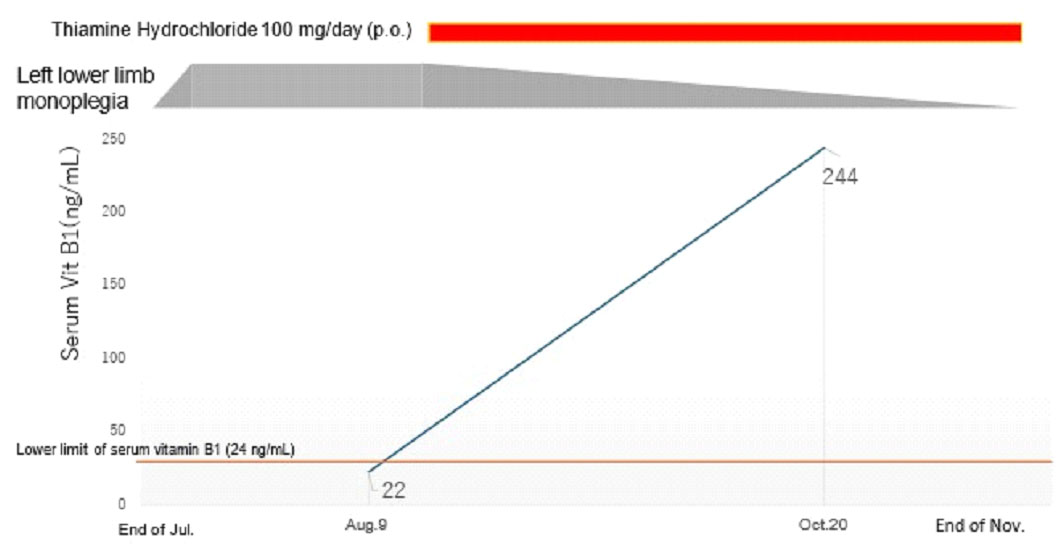
Blood laboratory testing showed white blood cells at 5300/μL, red blood cells at 450 × 104/μL, hemoglobin at 15.0 g/dL, and hematocrit at 44.8%; mean corpuscular volume was 99.6 fL, platelets were 23.3 × 10⁴/μL, total protein was 6.7 g/dL, albumin was 4.4 g/dL, aspartate transferase was 19 U/L, alanine aminotransferase was 14 U/L, blood urea nitrogen was 13.4 mg/dL, creatinine was 0.55 mg/dL, sodium was 146 mEq/L, potassium was 4.1 mEq/L, c-reactive protein was 0.0 mg/dL, blood sugar was 110 mg/dL, and hemoglobin A1c was 4.7%. Serum vitamin B1 was 22 ng/mL, below the normal lower limit (24–66 ng/mL).
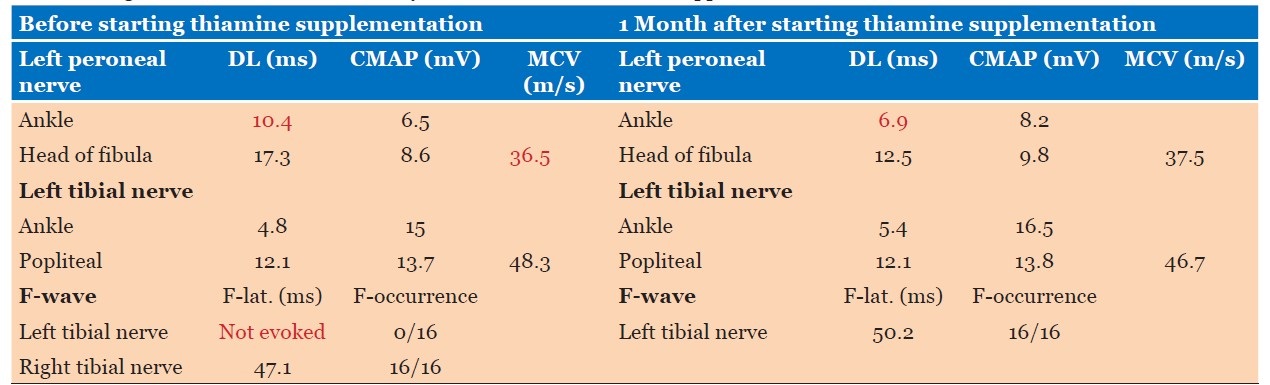
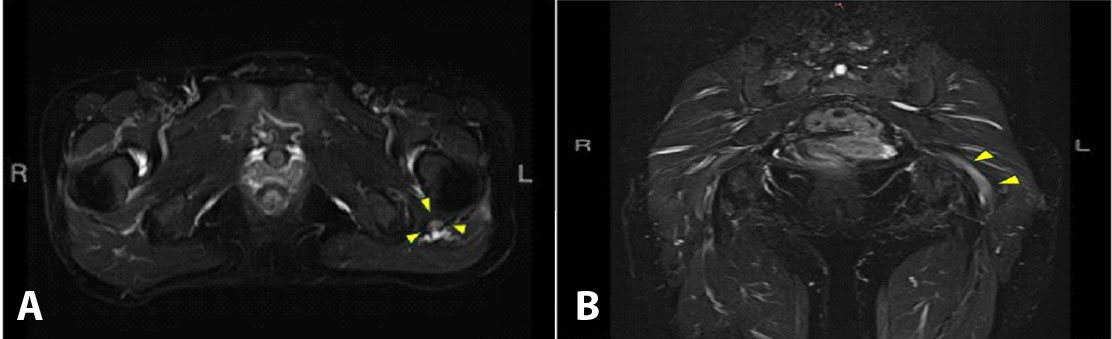
A nerve conduction study revealed damage to the left peroneal nerve and disturbances in the left tibial nerve. F-wave was absent in the left tibial nerve (Table 1). Pelvic magnetic resonance imaging (MRI) revealed short T inversion recovery (STIR) signal elevation, swelling, and damage in the left sciatic nerve at the level of the femoral head and trochanter, suggesting inflammation and ischemia (Figure 1). As there was a clear difference between the left and right sides, the possibility of beriberi was considered low. These results, in addition to extensor and flexor muscle weakness, suggested the involvement of the left sciatic nerve; however, the patient had had no hip trauma or surgery.
In this case, the patient had a low serum vitamin B1 level. Additionally, the patient experienced appetite loss and chronic alcohol use related to depression prior to symptom onset, which were considered contributing factors to the thiamine deficiency. Dry beriberi neuropathy may manifest rapidly over a few days mimicking Guillain–Barré syndrome (GBS). The clinical features of thiamine deficiency typically begin with distal sensory loss, burning pain, paresthesia, or muscle weakness affecting the toes and feet. In this case, it is possible that muscle weakness in the left lower limb preceded the onset of other symptoms.
The neurologist suggested thiamine supplementation therapy as a differential diagnosis. After supplementation with thiamine hydrochloride (100 mg/day) was initiated, left leg monoplegia immediately improved. At the end of August, the patient could walk using a cane. Muscle weakness was still present (0/5 in the left tibialis anterior, left gastrocnemius, and left extensor hallucis), though not in the hamstrings, which improved to 5/5. At the end of September, the patient could independently walk, and muscle weakness improved to 5/5 in all areas, though sensory disturbances persisted. By the end of November, the patient was completely cured after approximately four months of vitamin B1 supplementation and rehabilitation (Figure 2).
DISCUSSION
The patient in this case showed left leg monoplegia in both the extensor and flexor muscle groups. A nerve conduction study revealed disturbances in the left peroneal and tibial nerves. Pelvic MRI showed STIR signal elevation and swelling in the sciatic nerve. Together, these findings suggested that the left sciatic nerve was affected. Sciatic nerve injury commonly occurs due to trauma (pressure, stretching, or cutting) to the nerve and can cause symptoms such as paresthesia, loss of muscle power, and pain [4],[5],[6],[7],[8],[9],[10],[11],[12]. In this case, the patient had no hip trauma or surgery. Lumbar spine MRI showed only slight disc bulging at L4/5. It was difficult to determine the cause of unilateral sciatic neuropathy in this case.
Asymmetric neuropathy may occur in various conditions, including vasculitis, inflammatory conditions, diabetes, and nutritional neuropathies such as beriberi. The patient’s serum vitamin B1 level was below the normal range. Thiamine deficiency is rare in industrialized countries and is most commonly observed in the context of chronic alcohol use. In this case, the patient experienced appetite loss and chronic alcohol use due to depression for three months prior to symptom onset, which were considered contributing factors to the development of thiamine deficiency.
Peripheral neuropathy due to thiamine deficiency is said to have a similar onset pattern to GBS, typically presenting with motor paralysis and sensory impairment that begins in the lower limbs and gradually ascends to the upper limbs [4],[5],[6],[7],[8],[9],[10]. In this case, it is possible that muscle weakness in the left lower limb preceded symptom onset.
Based on these findings, thiamine supplementation was initiated as a differential diagnosis. Following treatment, left leg monoplegia immediately improved. The patient was completely cured after approximately four months of B1 supplementation and rehabilitation. In cases of dry beriberi, neurological improvement may take 3–6 months, with motor symptoms typically responding more favorably than sensory symptoms [9]. This case suggests the need to consider the possibility of neurological damage due to vitamin deficiency even in cases of atypical monoplegia, which may lead to earlier detection, treatment, and cure.
CONCLUSION
In this case, monoplegia was found to be due to vitamin B1 deficiency, and the patient was completely cured with vitamin B1 supplementation. This case suggests the need to consider the possibility of neurological damage due to vitamin deficiency, even in cases of monoplegia. Routine vitamin B1 testing should be considered in similar clinical cases to facilitate early diagnosis and intervention.
REFERENCES
1.
Bâ A. Metabolic and structural role of thiamine in nervous tissues. Cell Mol Neurobiol 2008;28(7):923–31. [CrossRef]
[Pubmed]

2.
Daroff RB, Jankovic J, Mazziotta JC, Pomeroy SL. Bradley’s neurology in clinical practice. 7th ed. London, New York: Elsevier; 2016.
3.
Sriram K, Manzanares W, Joseph K. Thiamine in nutrition therapy. Nutr Clin Pract 2012;27(1):41–50. [CrossRef]
[Pubmed]
4.
Koike H, Ito S, Morozumi S, Kawagashira Y, Iijima M, Hattori N, et al. Rapidly developing weakness mimicking Guillain-Barré syndrome in beriberi neuropathy: Two case reports. Nutrition 2008;24(7– 8):776–80. [CrossRef]
[Pubmed]
5.
Murphy C, Bangash IH, Varma A. Dry beriberi mimicking the Guillain-Barre syndrome. Pract Neurol 2009;9(4):221–4. [CrossRef]
[Pubmed]
6.
Koike H, Iijima M, Mori K, Hattori N, Ito H, Hirayama M, et al. Postgastrectomy polyneuropathy with thiamine deficiency is identical to beriberi neuropathy. Nutrition 2004;20(11–12):961–6. [CrossRef]
[Pubmed]
7.
Shible AA, Ramadurai D, Gergen D, Reynolds PM. Dry beriberi due to thiamine deficiency associated with peripheral neuropathy and Wernicke’s encephalopathy mimicking Guillain-Barré syndrome: A case report and review of the literature. Am J Case Rep 2019;20:330–4. [CrossRef]
[Pubmed]
8.
Faigle R, Mohme M, Levy M. Dry beriberi mimicking Guillain-Barre syndrome as the first presenting sign of thiamine deficiency. Eur J Neurol 2012;19(2):e14–5. [CrossRef]
[Pubmed]
9.
Koike H, Misu K, Hattori N, Ito S, Ichimura M, Ito H, et al. Postgastrectomy polyneuropathy with thiamine deficiency. J Neurol Neurosurg Psychiatry 2001;71(3):357–62. [CrossRef]
[Pubmed]
10.
Riahi A, Mansour M, Bedoui I, Derbali H, Messelmani M, Zaouali J, et al. Acute beriberi neuropathy mimicking Guillain-Barré syndrome after a strict vegetarian diet. Iran J Neurol 2017;16(2):100–2.
[Pubmed]
11.
Cherian RP, Li Y. Clinical and electrodiagnostic features of nontraumatic sciatic neuropathy. Muscle Nerve 2019;59(3):309–14. [CrossRef]
[Pubmed]
12.
Distad BJ, Weiss MD. Clinical and electrodiagnostic features of sciatic neuropathies. Phys Med Rehabil Clin N Am 2013;24(1):107–20. [CrossRef]
[Pubmed]
SUPPORTING INFORMATION
Acknowledgments
We would like to thank Editage (www.editage.jp) for English language editing.
Author ContributionsNobuko Shiraiwa - Conception of the work, Design of the work, Acquisition of data, Analysis of data, Drafting the work, Revising the work critically for important intellectual content, Final approval of the version to be published, Agree to be accountable for all aspects of the work in ensuring that questions related to the accuracy or integrity of any part of the work are appropriately investigated and resolved.
Akio Iwanami - Conception of the work, Design of the work, Acquisition of data, Analysis of data, Revising the work critically for important intellectual content, Final approval of the version to be published, Agree to be accountable for all aspects of the work in ensuring that questions related to the accuracy or integrity of any part of the work are appropriately investigated and resolved.
Satoshi Ayuzawa - Conception of the work, Design of the work, Acquisition of data, Analysis of data, Revising the work critically for important intellectual content, Final approval of the version to be published, Agree to be accountable for all aspects of the work in ensuring that questions related to the accuracy or integrity of any part of the work are appropriately investigated and resolved.
Norio Ohkoshi - Conception of the work, Design of the work, Acquisition of data, Analysis of data, Drafting the work, Revising the work critically for important intellectual content, Final approval of the version to be published, Agree to be accountable for all aspects of the work in ensuring that questions related to the accuracy or integrity of any part of the work are appropriately investigated and resolved.
Guaranter of SubmissionThe corresponding author is the guarantor of submission.
Source of SupportNone
Consent StatementWritten informed consent was obtained from the patient for publication of this article.
Data AvailabilityAll relevant data are within the paper and its Supporting Information files.
Conflict of InterestAuthors declare no conflict of interest.
Copyright© 2025 Nobuko Shiraiwa et al. This article is distributed under the terms of Creative Commons Attribution License which permits unrestricted use, distribution and reproduction in any medium provided the original author(s) and original publisher are properly credited. Please see the copyright policy on the journal website for more information.